
Custom Formulation vs Private Label: Who Owns Your Pet Supplement Formula?

By Sarthak | Last reviewed September 2026
Quick answer: White label is a manufacturer's ready-made formula sold under your brand. Private label is an existing base formula adapted for you, usually exclusive to your brand. Custom formulation is a formula built from scratch around your brief. The bigger question is who owns the formula, and that is decided by your contract, not by the name of the route.
Suppliers use these three terms loosely, and sometimes interchangeably, which is why so many brands end up with a product that is less exclusive than they thought. Two questions cut through the confusion: how different will your product be from everyone else's, and who will own the formula once it exists?
IndoFolk Wellness makes pet supplements through all three routes, so we have no reason to push you towards one. This guide focuses on the difference between private label and custom formulation, and on formula ownership. If you want the basics of white label versus private label first, read Private Label vs White Label Pet Supplements: What's the Difference?
White Label: A Ready Formula With Your Label
The manufacturer already has a finished, tested formula. You choose it, put your brand on the pack and sell it. Nothing about the formula changes.
Pros: the fastest route to market, the lowest upfront cost, usually the lowest MOQs, and a formula that already has a production history.
Cons: the same formula can be sold to other brands, so your product is only as different as your packaging and marketing. You own your brand, not the formula.
Who it suits: brands testing a new market or category, brands with a tight launch window, and channels where price and availability matter more than formula.
Private Label: An Existing Formula Adapted for You
Private label starts from a base formula the manufacturer already knows how to make, then adapts it for your brand. Typical changes include the dose, the flavour, the format (for example powder to liquid or soft chew), the pack size, the standardisation level of an extract, or adding or swapping one ingredient. Done properly, the adapted version is exclusive to you.
Pros: much faster than starting from scratch, built on a formula with manufacturing experience behind it, and genuinely different from the manufacturer's white label version.
Cons: the base formula still belongs to the manufacturer, there is a limit to how far it can be changed, and how exclusive your version is depends entirely on what your contract says.
Who it suits: most first launches. It gives you a distinct product in a proven category without the time and cost of full development.
Custom Formulation: Built From Scratch for Your Brand
With custom formulation, you start from a brief rather than an existing formula: the benefit you want to support, the species and life stage, your market, your preferred format, your price point and your ingredient story. The formulation team designs a formula around it, then it goes through sample rounds, stability testing and approval.
Time. In our experience, custom formulation from brief to an approved commercial sample typically takes 8 to 16 weeks, depending on complexity, stability requirements and regulatory review. Packaging, production and shipping come after that. Adapting an existing formula moves faster.
Cost. The main cost drivers are development rounds, sourcing any new raw materials, new stability testing and, often, a higher first MOQ because the production run is dedicated to your formula.
Pros: real product differentiation, the clearest path to owning your formula outright, and a stronger story for premium retailers, distributors and investors.
Cons: the slowest and most expensive route upfront, and you carry more of the risk if the product does not sell.
Who it suits: brands whose whole proposition rests on a unique formula, brands entering crowded categories, and founders who plan to raise investment or sell the business.
White Label vs Private Label vs Custom Formulation Compared
| White label | Private label | Custom formulation |
Speed to market | Fastest | Fast | Slowest (8 to 16 weeks to an approved sample) |
Typical MOQ | Usually lowest | Moderate | Often higher |
Upfront cost | Lowest | Low to moderate | Highest |
Differentiation | Packaging and marketing only | Formula tweaks plus packaging | A unique formula |
Who owns the formula | The manufacturer | Usually the manufacturer, exclusive to you | Usually you, if the contract says so |
Best for | Testing a market, fast launches | Most first launches | Formula-led and premium brands |
Who Owns the Formula? Ownership, Exclusivity and Licensing
This is the part most brands skip, and the part that matters most later. There are three common positions:
The manufacturer owns it and can sell it to others. This is standard white label. You own your brand, name and artwork, not the product inside.
The manufacturer owns it, but it is exclusive to you. Common in private label. Nobody else can buy your version, but you usually cannot take the formula to another manufacturer without permission.
You own it outright. Most common with custom formulation. The formula and its specifications are assigned to you, so you can move production if you ever need to.
Ownership matters most at three moments: when you want to change manufacturer, when you raise investment, and when you sell the business. Buyers and investors check who owns the product. Exclusivity alone is worth less than ownership, because it disappears if the relationship ends.
What to put in your contract
A precise definition of the formula: ingredients, amounts, specifications, extract standardisation and key process notes.
Who owns it, and from when: for example, on payment of development fees or on your first production order.
The scope of exclusivity: which product, which markets, for how long, and whether it depends on minimum annual volumes.
The manufacturer's pre-existing know-how: base formulas and processes that stay theirs, so both sides know where the line sits.
Later improvements: who owns a reformulated version if the formula is changed after launch.
Exit terms: if you own the formula, the right to receive its full documentation so another facility can make it.
Confidentiality in both directions, and confirmation that your brand name, trademark and label artwork are yours under every route.
This is general guidance, not legal advice. Have a lawyer review any development or supply agreement before you sign.
How we handle it at IndoFolk Wellness
Private label and custom formulas we develop for a brand are exclusive to that brand, and we agree formula ownership in writing before development starts. With white label, the formula stays ours while your brand, name and artwork stay yours. Whichever route you choose, you will know exactly what you are buying before you pay for development.
Which Route Suits Which Kind of Brand?
You need stock within weeks, or you are testing a new market: white label.
It is your first product, you want to stand out, and budget is limited: private label.
Your brand is built on a unique formula, you sell into premium retail, or you plan to raise money or sell: custom formulation, with ownership in writing.
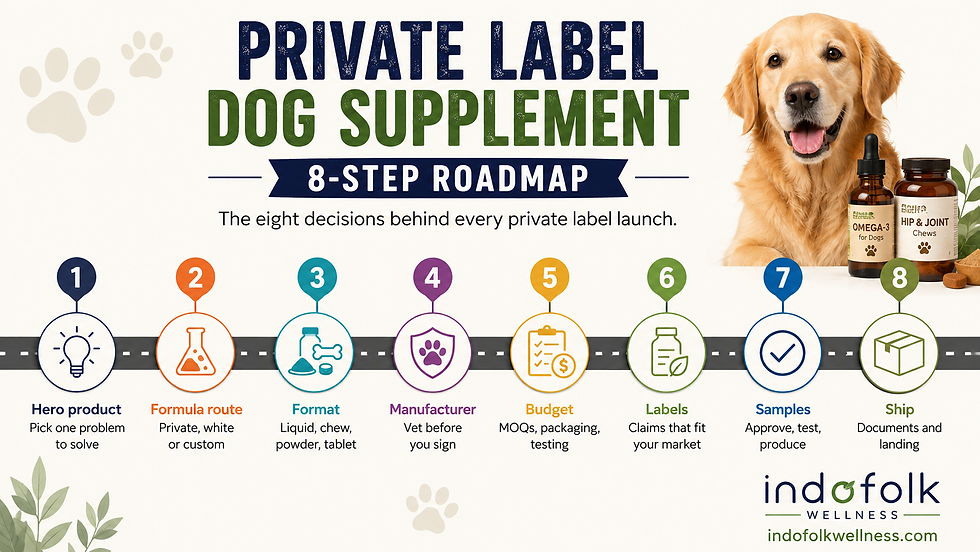
The routes are not a one-time choice. Many brands start with white label to prove demand, move their best seller to private label once it is selling, and invest in a custom formula for their flagship product. For the full launch process, from hero product to shipping, see our guide on how to launch a private label dog supplement brand, and before you sign with anyone, read how to choose the right private label pet supplement manufacturer.
Frequently Asked Questions
What is the difference between private label and custom formulation?
Private label adapts a manufacturer's existing base formula for your brand, for example by changing the dose, flavour, format or pack size. Custom formulation creates a new formula from scratch around your brief. Private label is faster and cheaper; custom formulation gives you a unique product and a clearer path to owning the formula.
Who owns the formula in a private label agreement?
It depends on the contract. In many private label agreements the manufacturer keeps ownership of the base formula but makes your version exclusive to your brand. Some agreements assign the formula to the brand. Get ownership, exclusivity scope and exit terms in writing before development starts.
Is custom formulation worth it for a new pet brand?
Custom formulation is worth it for a new pet brand when the brand depends on a unique formula, is entering a crowded category, or plans to raise investment or sell the business. For most first launches, private label gets a distinct product to market faster and with less upfront risk, and you can move to a custom formula once the product is selling.
How long does custom pet supplement formulation take?
Custom pet supplement formulation typically takes 8 to 16 weeks from brief to an approved commercial sample, depending on formula complexity, stability requirements and regulatory review. Packaging, production and shipping follow after that. Adapting an existing private label formula is usually faster.
Not Sure Which Route Fits?
Tell us your product idea and we'll recommend one, with indicative costs. Share the product, the market you want to sell in and roughly how many units you expect to order, and we will come back with the route we would suggest and why.
Related Reading
This article is general information for businesses and is not legal advice. Contract terms vary by manufacturer and project. Have a qualified lawyer review any agreement before you sign.
Comments