
How to Launch a Private Label Dog Supplement Brand: A Step-by-Step Guide for 2026

By Sarthak | Last reviewed September 2026
Quick answer: To launch a private label dog supplement brand, pick one hero product in a proven category, decide how much of the formula you want to own, choose a format, vet a manufacturer, and budget for MOQs, packaging and testing. Then get your labels and claims right for your market, approve samples, run stability testing and your first production batch, and ship with the correct documents. A private label product on an existing formula usually takes several months from brief to shelf, and a fully custom formula takes longer.
Most people who want to start a dog supplement brand already know who they want to sell to. They have an audience on Instagram, a pet store, a grooming business, a vet network, or a gap they have spotted on Amazon. What they usually do not know is how the product actually gets made, what it costs, and where first-time brands lose time and money.
At IndoFolk Wellness we develop private label pet supplements in India for pet brands, importers and distributors, and the same questions come up in almost every first conversation. This guide answers them in the order you will face them. For a wider look at launching supplements across dogs and cats, see our guide to launching a private label pet supplement brand.
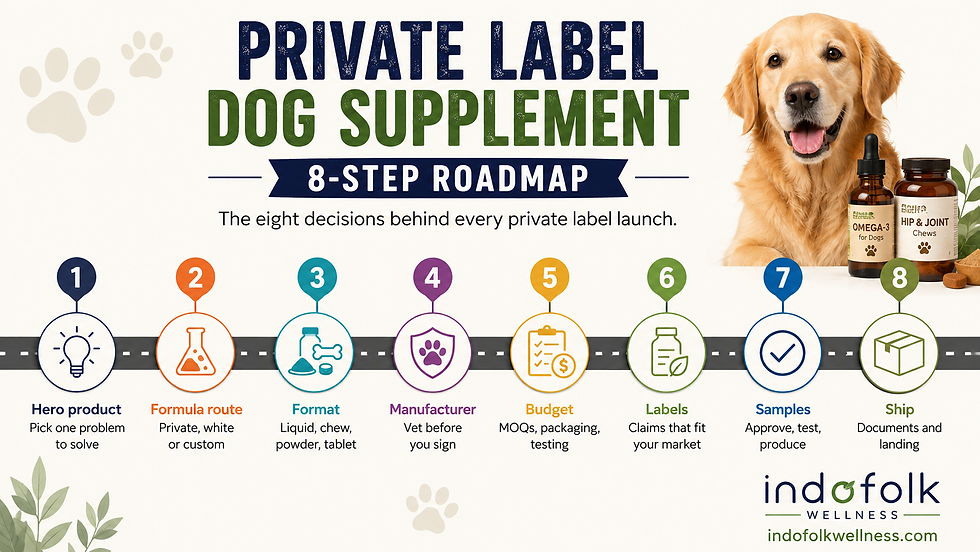
It is written for founders, product managers and sourcing leads planning a first dog supplement, or a first product with a new manufacturer. You do not need a science background. You do need to make eight decisions, and most of them affect each other.
Why Dog Supplements Are a Strong Category to Launch In
Dog supplements have become one of the most active corners of the pet market. Dog owners increasingly treat their dogs' health the way they treat their own, and many already take supplements themselves. Vets are also more willing to recommend supplements alongside treatment, particularly for older dogs. Four categories account for most of the demand, and each suits a clear customer problem:
Joint and mobility. The largest and most established category. It serves older dogs, large breeds and active dogs, and customers tend to buy it every month for years.
Calming and stress. Driven by separation anxiety, noise fears such as fireworks and storms, and travel. Strong seasonal peaks.
Gut and digestion. Probiotics, prebiotics and digestive herbs for sensitive stomachs, diet changes and general wellness.
Skin and coat. Omega-3s and supporting nutrients for itching, dull coats and shedding.
Multivitamins and immune support make up much of the rest.
Why brands source from India
India has three advantages for this category. First, many of the botanical ingredients used in pet wellness, including Boswellia serrata (Shallaki), turmeric and ashwagandha, are grown and processed here, which shortens the supply chain. Second, manufacturing costs are generally competitive with other major supplement-producing countries. Third, Ayurveda gives Indian formulators a long working familiarity with these herbs, which helps when you want a product that stands out. We cover this in more depth in why India is a strong base for private label pet supplements and our guide to Ayurvedic ingredients for pet supplements.
Step 1: Pick Your First Category and Hero Product
The most common mistake first-time brands make is launching with five products. Five SKUs means five sets of MOQs, five packaging runs, five labels to check and five stories to tell. Most successful brands start with one hero product, prove that customers reorder it, then expand. To choose yours, answer these questions on one page:
Which dog? Senior large breeds, anxious rescues, puppies, dogs with sensitive stomachs. The narrower the better at launch.
Which buyer? A first-time dog parent buys differently from a breeder or a vet clinic.
Which market? The US, UK, EU, UAE and India have different label rules, format preferences and price points.
Which channel? Your own website, Amazon, pet specialty retail, vet clinics or groomers. Channel affects pack size, pricing and even format.
What price? Work backwards from the shelf price your customer will accept to the product cost you can afford.
Why you? An ingredient story such as Ayurvedic botanicals, a format such as liquid drops for fussy dogs, a price point, or a specific dog.
A joint supplement for senior large-breed dogs, sold direct to consumers in the UK, is a hero product. "A range of wellness supplements for all dogs" is not.
Step 2: Choose Between Private Label, White Label and Custom Formulation
Before you talk about ingredients, decide how much of the formula you want to own. There are three routes:
| White label | Private label | Custom formulation |
What it means | The manufacturer's existing formula with your branding | An existing base formula adapted for you (dose, flavour, pack size, an added ingredient) | A formula developed from scratch for your brand |
Speed to market | Fastest | Fast | Slowest |
Differentiation | Low, others may sell the same formula | Medium | High |
Development cost | Lowest | Low to moderate | Highest |
Who owns the formula | Usually the manufacturer | Depends on your contract | Usually you, if the contract says so |
For most first launches, private label is the sensible middle path. You get to market in months rather than a year, with enough adaptation to be distinct. Custom formulation makes sense when your whole brand rests on a unique formula, or when you are entering a crowded category and need a real point of difference.
Whichever route you choose, get formula ownership in writing before development starts. We explain the trade-offs in detail in Private Label vs White Label Pet Supplements: What's the Difference?
Step 3: Choose a Format

Format is not just a packaging decision. It affects which ingredients you can include and at what dose, how long the product lasts, how it survives shipping, your MOQ and your cost. At IndoFolk Wellness we work across soft chews, powders, tablets, liquids and functional treats, and these are the trade-offs we talk brands through most often:
Format | Palatability | Dose flexibility | Heat and shelf stability | Typical strengths |
Liquid drops | Good, added to food or given directly | High, easy to dose by body weight | Good with the right formulation and packaging | Fussy eaters, older dogs, dogs who refuse pills |
Soft chews | Excellent, feels like a treat | Fixed per chew | More sensitive to heat and humidity | Consumer appeal, markets where chews dominate |
Powders | Moderate, mixed into food | High | Good if kept dry | High-dose ingredients, cost-effective, larger dogs |
Tablets | Lower, some dogs refuse them | Fixed per tablet | Very good | Low cost, long shelf life, easy to ship |
Two practical points. If your product will spend weeks in transit or in a hot warehouse, ask your manufacturer how the format holds up in those conditions. And if your key ingredient needs a high dose, check that it physically fits into one chew or tablet before you fall in love with the format.
Step 4: Choose and Vet a Manufacturer
Your manufacturer is the most important partner you will have. A good one saves you from mistakes you do not yet know you are making. A poor one can cost you your launch, your reviews or your marketplace listing. Ask every shortlisted manufacturer for evidence, not promises, on these points:
Certifications relevant to your product and market, with copies you can check. Ask what each certificate covers and when it expires.
A certificate of analysis (COA) for every batch, showing identity, active ingredient levels and safety tests such as heavy metals and microbial limits.
Stability data, or a plan to generate it, so your shelf life claim is backed by testing.
Ingredient traceability. Where does each raw material come from, and how is it tested on arrival?
Regulatory knowledge for your market. They will not replace your own compliance adviser, but they should know what your market's label needs.
Samples and responsiveness. How quickly do they send samples and answer technical questions? Early communication is the best predictor of later communication.
Capacity to grow with you. Can they handle your third order at five times the size of your first?
Clear terms on MOQs, lead times, payment, formula ownership and what happens if a batch fails testing.
Red flags: no batch COAs, vague answers about sourcing, reluctance to share certificates, prices far below everyone else's, and pressure to skip samples. Our buyer's guide on how to choose the right private label pet supplement manufacturer covers each of these in more detail.
Step 5: Budget for MOQs, Packaging and Testing
First-time brands usually budget for the product and forget almost everything around it. Your launch budget has eight lines:
Formulation and development, mostly for custom formulas and significant private label changes.
Ingredients, where your active ingredients and their doses drive most of the product cost.
The minimum order quantity (MOQ) for each SKU. MOQs exist because a production run has fixed set-up and cleaning costs. They vary by format and by manufacturer.
Packaging, meaning bottles, droppers, caps, tubs, labels and cartons. Packaging suppliers often have their own MOQs, separate from the product MOQ, and custom packaging can have the longest lead time in the whole project.
Testing, covering batch COAs, stability testing and any third-party testing your market or retailer requires.
Label and regulatory review for your market.
Freight, duties and customs clearance.
Launch stock and reorder buffer. Plan for your second order before your first one sells out.
Ways to lower first-order risk:
Launch one SKU in one pack size.
Use a stock bottle or tub with a custom label rather than custom-moulded packaging.
Choose a format with a lower MOQ for your first run, if it suits the product.
Ask whether a smaller pilot run is possible, then scale up after launch.
Step 6: Get Labels and Claims Right for Your Market
This step causes more expensive problems than any other. A label that is wrong for your market can mean relabelling a full production run, a shipment held at customs, or a marketplace listing taken down. Every market has its own rules on what must appear on the label (ingredients, amounts, directions, warnings, the responsible business) and what you are allowed to say. At a high level:
United States: animal supplements fall under FDA oversight, and many brands choose to join the National Animal Supplement Council (NASC), whose Quality Seal is voluntary but widely recognised by retailers.
United Kingdom and European Union: dog supplements are generally sold as complementary feed, with specific labelling requirements under feed law.
UAE and GCC: pet products generally need registration and approval before import, and labels may need Arabic.
The single most important rule is the same everywhere: supplements support normal health, they do not treat disease.
Avoid | Use instead |
Cures arthritis | Supports healthy joints and mobility |
Treats anxiety | Helps dogs feel calm during stressful situations |
Prevents digestive disease | Supports healthy digestion |
Claims are not only on the label. Your website, Amazon listing, social posts and even how you use customer reviews all count. This article is general guidance, not legal advice. Always have your final label checked by someone qualified in each market you sell to.
Step 7: Samples, Stability Testing and Your First Production Run

This is where your product becomes real. Expect one to three rounds of samples, and judge each round on:
Palatability. Test with real dogs, ideally 10 or more of different sizes and ages, not just your own. A supplement that dogs refuse will not get reordered.
Smell, colour and texture. Owners notice these before dogs do.
Ease of use. Does the dropper measure cleanly? Do the chews break apart in the tub?
When you are happy, sign off a gold standard sample and a written product specification. Every future batch is checked against these.
Stability testing shows how your product holds up over time, at normal and elevated temperatures and humidity, so you can support the shelf life on your label. Accelerated testing gives early indications within weeks or months, and real-time testing confirms the result over the full shelf life. Ask your manufacturer what data already exists for similar formulas and what new testing your product needs.
Before your first production run, confirm the final label artwork, packaging delivery dates and batch size. After production, you should receive a COA for the batch, and your manufacturer should keep retained samples. Check the first units yourself before they ship.
Step 8: Shipping, Documents and Landing the Product
The product is made. Now it has to reach your warehouse, legally and in good condition.
Agree who handles what. Your Incoterm, the standard trade term in your contract, decides where your manufacturer's responsibility ends and yours begins. Under EXW, you collect from the factory. Under FOB, the manufacturer delivers to the port of export. Under CIF, they also cover freight and insurance to your port. Under DDP, they deliver to your door with duties paid. First-time importers often find FOB or CIF with a good freight forwarder the easiest balance of cost and control.
Documents you will typically need:
Commercial invoice and packing list
Certificate of analysis for the batch
Safety data sheet (SDS or MSDS)
Certificate of origin
Any market-specific certificates, such as health or free-sale certificates, where your market requires them
The correct HS code for customs classification. Confirm this with your customs broker, as classification decides your duty rate.
You also need an importer of record in your market, the business legally responsible for the goods at customs. That may be you, your distributor or your freight forwarder. And if you chose soft chews or a heat-sensitive formula, ask about packaging and shipping methods that limit heat exposure in transit.
A Realistic Launch Timeline
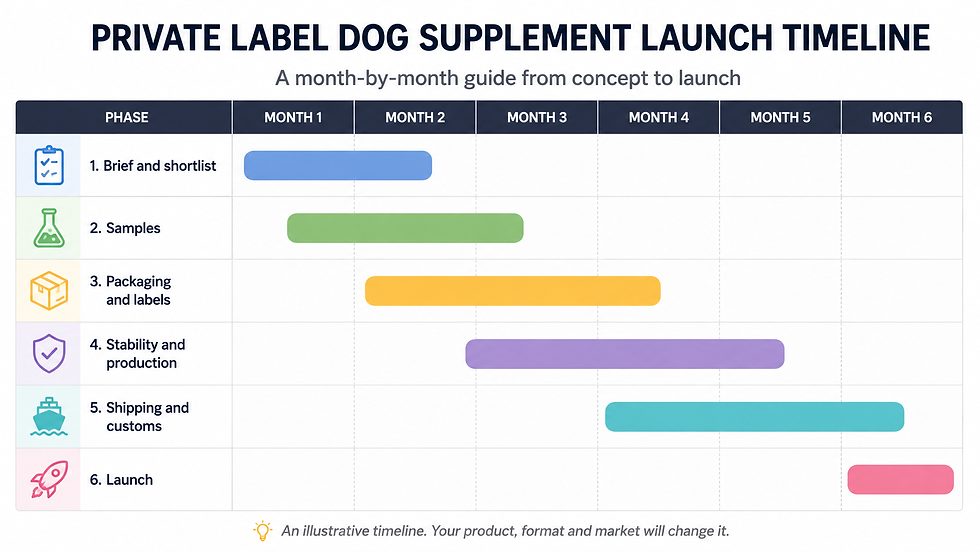
Every project is different, and your product, format and market will change the picture. As an illustration, a well-run private label launch on an existing formula often looks like this:
Month | What happens |
1 | Brief, hero product, market and channel decided. Manufacturer shortlisted and vetted. Quote agreed. |
1 to 2 | Sample rounds and palatability testing. Gold standard sample approved. |
2 to 3 | Label artwork, claims review for your market, packaging ordered. |
3 to 4 | Packaging arrives. Production run. Batch COA issued. |
4 to 5 | Shipping, customs clearance, stock into your warehouse. |
5 to 6 | Launch. Plan your reorder. |
Custom formulation: add development rounds and new stability testing at the start. Custom projects often take roughly twice as long as private label.
What usually causes delays: custom packaging lead times, late label approvals, extra sample rounds, and documents that were not agreed before shipping. The fix for all four is the same: decide early and put it in writing.
Five Mistakes First-Time Brands Make
Launching too many products. One hero product, done well, beats five average ones.
Copying a competitor's claims. Their label may be non-compliant, or written for a different market.
Skipping real palatability testing. Your own dog is not a test panel.
Forgetting packaging MOQs and lead times. The bottle can hold up the whole launch.
No reorder plan. Running out of stock three months after launch loses the customers you worked hardest to win.
Frequently Asked Questions
How much does it cost to start a private label dog supplement brand?
The cost to start a private label dog supplement brand depends mainly on your format, your ingredients, the MOQ for your first run, your packaging and your target market's testing and label requirements. Your launch budget should cover formulation, product at MOQ, packaging, testing, label review, freight and duties, and a reorder buffer. Launching one SKU with stock packaging keeps the first order smallest.
How long does it take to launch a private label pet supplement?
A private label pet supplement based on an existing formula often takes around four to six months from brief to launch, covering samples, labels, packaging, production and shipping. A fully custom formula usually takes longer because it needs development rounds and new stability testing. Custom packaging and late label approvals are the most common causes of delay.
Do I need my own formula to start a pet supplement brand?
No. Many successful pet supplement brands start with a white label or private label formula from their manufacturer and adapt it with their own dose, flavour, pack size or an added ingredient. Custom formulation is worth it when your brand depends on a unique formula. Whichever route you choose, agree formula ownership in writing before development starts.
What is the MOQ for private label pet supplements?
The minimum order quantity for private label pet supplements varies by manufacturer and format, because each production run has fixed set-up costs. Liquids, soft chews, powders and tablets often have different MOQs, and packaging suppliers may set their own minimums too. Ask for MOQs per SKU and per packaging component when you request a quote.
Ready to Plan Your First Product?
You do not need all the answers before you start. You need a clear idea of your hero product, your market and your channel. A good manufacturer will help you with the rest. Send us your brief, and we will come back with questions and an initial view on formulation, format and MOQs.
Related Reading
This article is general information for businesses and is not legal or regulatory advice. Requirements differ by market and change over time. Check your final product and label with a qualified adviser in each market you sell to.
Comments