
Root-only ashwagandha: how to verify leaf-free material with HPTLC

By the IndoFolk Wellness Care Team | Last reviewed October 2026
Quick answer: To verify root-only ashwagandha, ask for an HPTLC identity fingerprint on every lot, run against an authenticated root reference and showing no leaf or aerial-part markers. An HPLC withanolide assay alone cannot prove the plant part, because leaf also contains withanolides. A good CoA pairs HPTLC identity with the withanolide assay, heavy metals, microbiology and pesticide results, all tied to the same lot number.
Ashwagandha buyers increasingly write "root only, leaf-free" into their specifications, and in April 2026 India's regulators moved the same way, restricting leaf use in Ayush medicines and food products. The commercial pressure runs the other way: leaf is cheaper than root, and a published survey found that about one in five commercial "root" extract samples were not composed solely of authentic root. If your label says root, your testing has to prove it.
Why do buyers insist on root-only ashwagandha?
Three reasons come up in almost every specification we see:
Traditional use. Classical Ayurvedic use of Withania somnifera centres on the root. Botanical experts quoted in trade press note there is no historical precedent for using the leaves.
Indian regulation. In April 2026 the Ministry of Ayush directed Ayush drug manufacturers to use only ashwagandha root and not to use leaves in any form, and to identify the plant parts used on labels. The Food Safety and Standards Authority of India (FSSAI) followed with an advisory dated 16 April 2026 against using ashwagandha leaves "in crude or extract or any other form in food products". The Ayush letter cites safety concerns about higher concentrations of reactive withanolides in the leaves, particularly withaferin A.
Label accuracy. If a product says "ashwagandha root extract", leaf content makes the label inaccurate, whatever the market.
A note on markets: several EU member states have restricted or are reviewing ashwagandha in food supplements, and Germany's Federal Institute for Risk Assessment (BfR) advised in 2024 that certain groups, including children and pregnant or breastfeeding women, should not take ashwagandha supplements. We therefore do not recommend ashwagandha for EU-targeted products. This guide is written for buyers supplying the US, UK and other markets where it is sold, subject to your own regulatory review.
How common is leaf adulteration?
The published evidence is not reassuring:
Study | Method | What it found |
|---|---|---|
Botanical Adulterants Prevention Bulletin (2018) | HPTLC identity testing of 584 commercial root extract samples | 119 samples (20.4%) were not solely authentic root; leaf caused 84 rejections (14.0%) |
ISRN Analytical Chemistry (2014) | HPLC-UV targeting flavonol glycosides (aerial-part markers) | Only 2 of 10 commercial root extracts lacked aerial-part markers |
The economics explain why. Ashwagandha root costs about ₹235–330/kg in India, while leaf is a far cheaper by-product of the same crop. Where an extract is sold on withanolide percentage alone, adding leaf can raise the assay figure while lowering cost.

HPTLC fingerprinting vs HPLC withanolide assay: what does each prove?
This is the point most buyers miss. The two tests answer different questions.
HPTLC fingerprint | HPLC withanolide assay | |
|---|---|---|
Question it answers | Is this the right plant and the right plant part? | How much withanolide is present? |
Output | A pattern of bands compared with an authenticated reference | A percentage figure, e.g. total withanolides |
Detects leaf? | Yes, if the method looks for aerial-part markers such as flavonol glycosides | Not on its own: leaf also contains withanolides |
Pharmacopoeial basis | USP general chapter <203> sets an HPTLC procedure for identifying botanical articles | Assay methods set by the relevant monograph or validated in-house |
Best use | Identity and plant-part release test, every lot | Potency and standardisation claim, every lot |
In short, a high withanolide number does not prove root. A clean HPTLC fingerprint against authenticated root, with no leaf markers, does. Ask for both.
What should the HPTLC report actually show?
A one-line "HPTLC: complies" is not enough. Ask your supplier for the plate image or report itself, and check that it includes:
Reference standards: an authenticated ashwagandha root reference and, ideally, an authenticated leaf reference run on the same plate.
Sample track: your lot, labelled with the lot number on the CoA.
Leaf markers: a statement that bands characteristic of aerial parts were absent.
Method reference: the pharmacopoeial or validated method used, and the laboratory that ran it.
System suitability: evidence that the plate performed as the method requires.
If your supplier cannot share the plate image, ask why. For first orders, we suggest having an independent laboratory repeat the HPTLC on a retained sample.
What should a root-only ashwagandha CoA include?
CoA section | What to look for |
|---|---|
Identity | Botanical name, plant part stated as "root", HPTLC result vs authenticated root reference |
Assay | Withanolide content by HPLC, with the method named |
Extraction details | Solvent (e.g. water or hydro-alcoholic), drug-to-extract ratio, any carrier or excipient |
Heavy metals | Lead, cadmium, arsenic, mercury by ICP-MS, with limits stated |
Microbiology | Total plate count, yeast and mould, pathogens per your specification |
Pesticides and solvents | Multi-residue pesticide screen; residual solvents if solvent-extracted |
Traceability | Lot number, manufacturing and expiry dates, signed by the manufacturer's QA |
Under US dietary supplement rules (21 CFR 111.70), manufacturers must set an identity specification for each component, so a documented plant-part identity test is not optional for US brands. For our full testing framework, see our guide to testing Ayurvedic ingredients for pet products.
Root, root powder or extract: how does ashwagandha leave India?
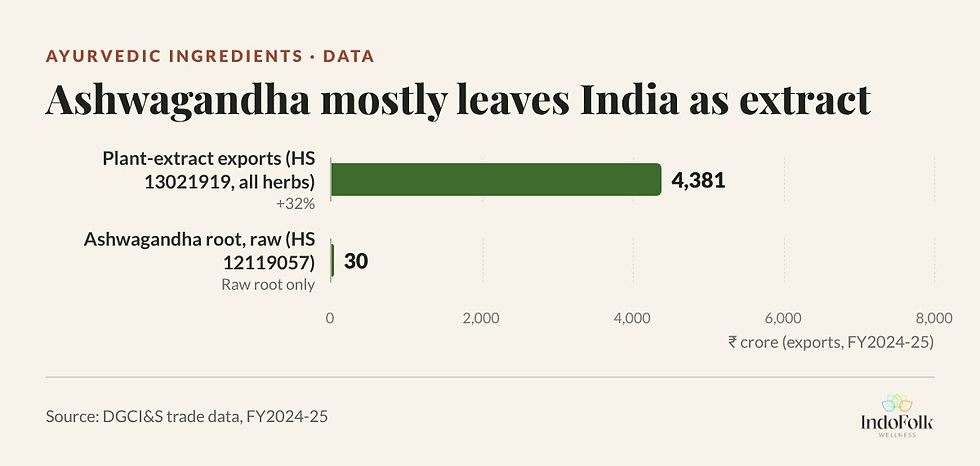
India's trade data shows a clear pattern. Raw ashwagandha root exports (HS 12119057) were only ₹30 crore in FY2024-25, while Indian plant-extract exports as a whole (HS 13021919) reached ₹4,381 crore, up 32%. Most ashwagandha leaves India as extract, which is exactly where plant-part verification matters most, because an extract no longer looks like root.
Data point | Figure | Source |
|---|---|---|
Ashwagandha root, raw exports (HS 12119057) | ₹30 crore | DGCI&S trade data, FY2024-25 |
Indian plant-extract exports (HS 13021919) | ₹4,381 crore, +32% | DGCI&S trade data, FY2024-25 |
Ashwagandha root price in India | ₹235–330/kg | Owner's market research, 2026 |
Generic extract landed in the US | about $39–45/kg | Owner's market research, 2026 |
When you compare quotes, check that the cheaper offer is the same plant part, extraction ratio and withanolide method. A low price on "ashwagandha extract" with no plant-part evidence is a warning sign rather than a bargain. For demand trends, see our ashwagandha export market analysis.
A practical verification workflow for buyers
Write it into the specification. "Withania somnifera root only; no leaf or aerial parts; HPTLC identity per lot."
Ask for the plate image with your sample request, not after the purchase order.
Test the sample independently with HPTLC against authenticated root and leaf references.
Lock the method. Agree which HPTLC and HPLC methods appear on every CoA.
Retain samples from each lot for at least the shelf life.
Re-test periodically, especially when the supplier changes its raw-material source or season.
Label accurately. State "root" or "root extract" only when your evidence supports it.
If you are formulating for animals, the same discipline applies; see our article on ashwagandha in pet calming supplements.
Frequently Asked Questions
Can HPLC alone confirm that ashwagandha is root-only?
Not reliably. A standard HPLC assay measures withanolides, and leaf also contains withanolides, so leaf addition can still produce an acceptable or even higher assay figure. HPLC methods that target aerial-part markers such as flavonol glycosides can help, but HPTLC fingerprinting against authenticated root and leaf references is the usual identity test. Ask for HPTLC plus HPLC on each lot.
Has India banned ashwagandha leaves?
In April 2026, India's Ministry of Ayush directed Ayush drug manufacturers to use only ashwagandha root, and FSSAI issued an advisory dated 16 April 2026 against using leaves in any form in food products. The Ayush letter cites safety concerns about leaf withanolides. Check the current text of both notices, and how they apply to your product, with your regulatory adviser.
What is HPTLC testing for herbs?
High-performance thin-layer chromatography (HPTLC) separates a botanical sample into a pattern of bands, or fingerprint, that is compared with authenticated reference material. It confirms species and plant part. USP general chapter <203> sets out a standardised HPTLC procedure for identifying articles of botanical origin, including dietary supplement ingredients.
Is root-only ashwagandha more expensive?
Usually, because root is the costlier part of the plant. In India, ashwagandha root currently costs about ₹235–330/kg, while generic extract lands in the US at about $39–45/kg. Unusually low extract prices without plant-part evidence deserve closer questions, not quicker approval.
Work With IndoFolk Wellness
IndoFolk Wellness is a sourcing and export coordination partner: we shortlist vetted Indian manufacturers, arrange samples at cost, and collect the documentation, including HPTLC identity and full CoAs, before you commit. If you need root-only ashwagandha for a US or UK formulation, request a quote or samples.
Related Reading
Sources
India bans ashwagandha leaf use in any form, industry reacts, NutraIngredients
Ayush bans ashwagandha leaf extracts, SupplySide Supplement Journal
Growing concerns over safety of ashwagandha in EU member states, NutraIngredients
21 CFR 111.70, Requirements to establish specifications, Legal Information Institute (Cornell)
This article is general information, not legal, regulatory or veterinary advice.


Comments